Table of Contents
- What Door Width Does Your Mower Actually Need?
- How Do You Measure the Deck and Attachments?
- Why Is Clear Opening Different From Door Size?
- How Much Turning Space Is Needed Outside the Door?
- What Ramp and Floor Specifications Should You Confirm?
- Which Shed Door Options Fit Your Equipment?
- FAQs
- Plan Your Shed Entrance Around Your Equipment
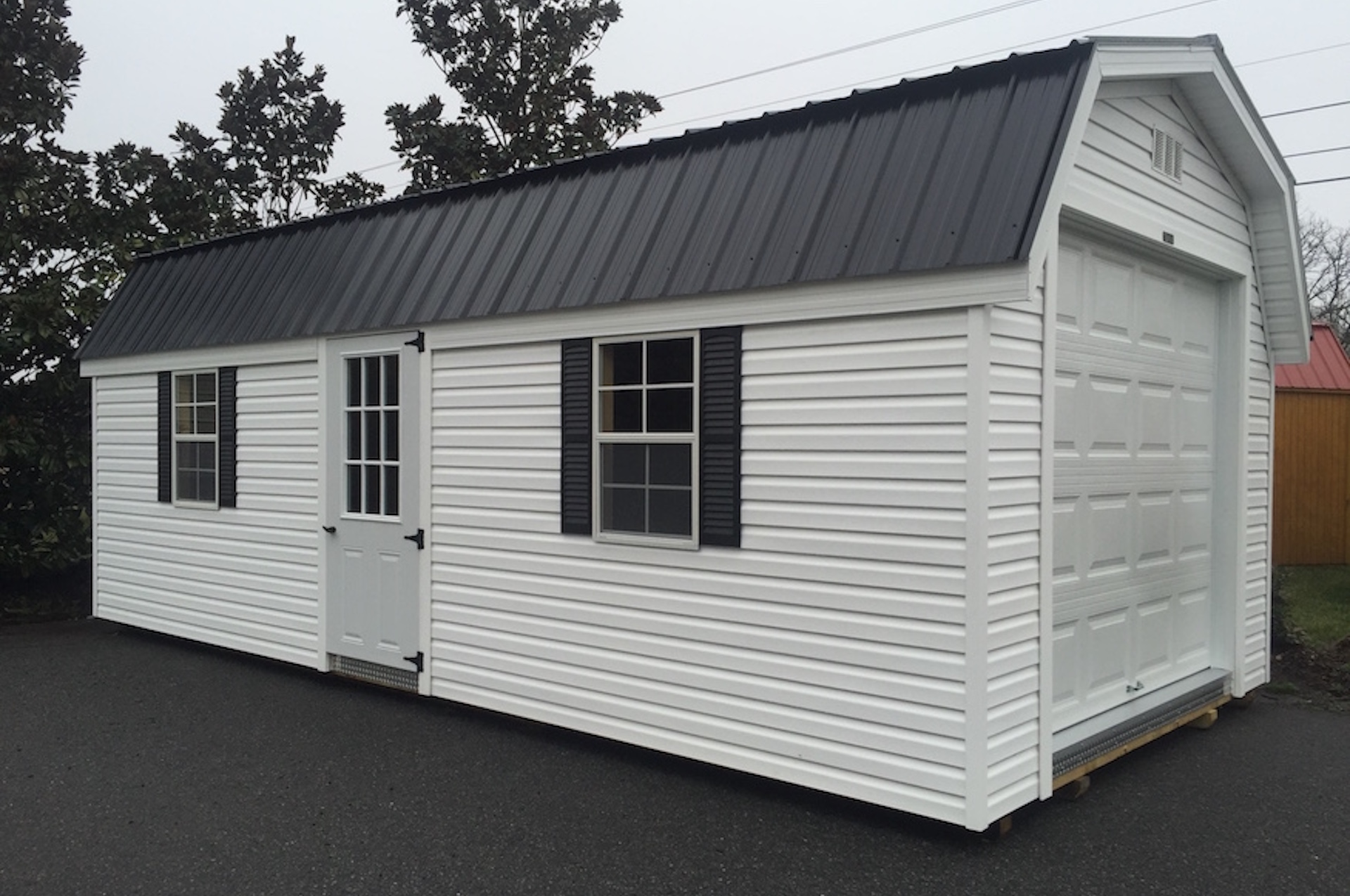
What Shed Door Width Do You Need for a Riding Mower?
The right shed door width for a riding mower depends on the equipment’s full width, including its cutting deck, discharge chute, and attachments. Measure the mower at its widest point, then allow additional clearance on both sides for safe entry.
A mower that fits through a doorway on paper may still scrape the frame if the opening is narrow or the approach is uneven. Before choosing a riding mower shed, compare the actual clear door opening with the mower’s dimensions. Ramp placement, turning space, and floor capacity also affect whether the equipment can enter safely.
What Door Width Does Your Mower Actually Need?
A riding mower typically needs a shed door several inches wider than its maximum overall width. The correct measurement is not necessarily the cutting width shown in the mower’s product description.
Riding mowers vary considerably in size. Compact lawn tractors may fit through openings that are too narrow for larger zero-turn models. Attachments can increase the required width even when two machines have similar cutting decks.
For practical planning, consider the following measurements:
-
Mower width: The widest point of the equipment, including the deck and discharge chute.
-
Door clearance: Additional space on each side to prevent contact with the frame.
-
Door configuration: Whether both door panels can open fully and remain secured.
-
Entry alignment: The space needed to approach the opening without turning sharply.
As a starting point, allowing approximately three to six inches of clearance on each side can make entry easier. This is a planning allowance, not a manufacturer-required minimum. Narrow approaches or difficult terrain may require more room.
Example: Choosing a Door for a 48-Inch Mower
Suppose a homeowner owns a riding mower with a 48-inch cutting width.
That measurement describes the area covered by the blades, not necessarily the mower’s outside dimensions.
For example, Husqvarna lists its MZ48 Special Edition zero-turn mower with a 48-inch cutting width. However, its published overall width is 61 inches with the discharge chute down and 56 inches with the chute raised.
A mower measuring 61 inches across would have approximately 5.5 inches of clearance on either side of a true 72-inch opening, assuming it enters centrally.
However, if the shed has a nominal 72-inch door assembly, its actual unobstructed opening may be smaller.
This illustrates why the shed door width for a riding mower must be based on overall equipment dimensions rather than cutting width alone.
Is a 60-Inch Door Wide Enough?
A 60-inch clear opening may accommodate some compact riding mowers, but it will be unsuitable for many larger machines.
Even if a mower measures 58 inches wide, a 60-inch opening leaves only one inch on each side when centered.
That provides little margin for steering corrections.
The better choice is a door that allows the mower to enter comfortably under normal operating conditions, without requiring repeated adjustments or contact with the doorway.
How Do You Measure the Deck and Attachments?
Measuring a riding mower requires checking more than its wheelbase or cutting deck.
The goal is to determine the equipment’s full outside dimensions in the configuration used when moving it into storage.
Start with the mower on level ground. Turn off the engine, remove the key, engage the parking brake, and follow the manufacturer’s instructions before measuring.
Measure the Widest Part of the Mower
Use a tape measure to check the distance between the furthest points on opposite sides.
Important components include:
-
Cutting deck: The exterior housing can extend beyond the advertised cutting width.
-
Discharge chute: Side-discharge components can significantly increase overall width.
-
Rear attachments: Bagging systems and collection equipment may change the mower’s overall dimensions.
-
Side accessories: Mounted equipment can create additional clearance requirements.
-
Roll bars and seat: These affect vertical clearance rather than width but still matter at the entrance.
Record the maximum overall width and height, along with the mower’s total length.
These measurements help establish whether the equipment will pass through the doorway and clear the header.
Does the Discharge Chute Change the Required Width?
Yes. On many mowers, the discharge chute extends beyond the cutting deck.
Some manufacturers publish separate machine widths with the chute raised and lowered. The difference can be substantial.
However, homeowners should not assume that every chute can be folded, removed, or secured in the same manner.
Follow the mower manufacturer’s instructions. Never remove required safety components merely to force equipment through a narrow opening.
For a mower fitted with a grass collection system, measure the complete setup if the attachments will remain installed during storage.
Why Measurements Should Be Rechecked
Equipment specifications may differ between model years and deck configurations.
A replacement mower may also be wider than the original machine.
For homeowners in Monroe or Midland comparing wood storage sheds, keeping a written record of equipment dimensions can prevent purchasing a building with an unsuitable entrance.
Measurements should always reflect the actual mower rather than an assumed standard size.
Why Is Clear Opening Different From Door Size?
A shed advertised with a 72-inch double door does not automatically provide exactly 72 inches of unobstructed entry space.
The listed door measurement may refer to the nominal door assembly, while the usable opening depends on its construction and hardware.
Components that can affect shed access clearance include door jambs, stops, overlapping panels, hinges, and other projections.
The key measurement is the clear opening between the nearest obstructions when the doors are fully opened.
How to Measure a Double-Door Opening
For an existing shed, open both door panels completely and secure them.
Measure the narrowest unobstructed horizontal distance at the height the mower’s widest components will pass through.
Also inspect the opening near the floor and at higher points where handles, attachments, or other mower components may approach the frame.
Check whether:
-
Both panels can remain fully open during entry.
-
Door hardware projects into the travel path.
-
The center meeting point creates an obstruction.
-
The threshold reduces usable clearance.
-
The doorway maintains sufficient height across its full width.
A doorway that is wide enough at the top may still have a narrow obstruction near the threshold.
Why Door Specifications Matter Before Ordering
A manufacturer’s published width is useful for comparing designs, but it should not replace a confirmed clear-opening measurement.
At Better Built Storage Buildings Inc., several of our published shed configurations list 72-inch double doors.
That specification provides a useful starting point. However, buyers should confirm the actual clear-opening dimensions for the selected model before deciding whether their mower will fit.
The same principle applies to customized door arrangements. Larger panels do not automatically guarantee easier access if the opening hardware or surrounding layout introduces restrictions.
How Much Turning Space Is Needed Outside the Door?
A sufficiently wide doorway will not solve an awkward approach.
A riding mower needs enough room outside the shed to line up with the opening before crossing the threshold.
The required distance varies according to the mower’s length, steering design, turning radius, and surrounding obstacles.
Straight Entry Is Usually Easier
A direct approach allows the mower to enter without making substantial steering corrections near the frame.
This becomes especially important when using a ramp.
If the mower approaches at an angle, its deck or rear wheels may move closer to one side of the opening than expected.
Homeowners should examine the space between the shed entrance and nearby features such as:
-
Fences and retaining walls
-
Trees and landscaping beds
-
Driveways and parking areas
-
Sloped or uneven ground
-
Gates and narrow yard passages
For example, a shed positioned beside a fence may have enough door width but insufficient room for a lawn tractor to approach directly.
Moving the doorway to another wall or changing the building’s orientation may create a more practical entrance.
Zero-Turn Mowers Still Need Approach Space
Zero-turn mowers can maneuver within relatively small areas, but that does not eliminate the need for alignment.
Sharp steering movements on a ramp can increase the risk of wheel misalignment or loss of traction.
Even with a highly maneuverable mower, a straight entry path is preferable when conditions permit.
The outdoor approach should also remain clear after landscaping changes or additional equipment is placed nearby.
What Ramp and Floor Specifications Should You Confirm?
Ramp compatibility and floor capacity are just as important as doorway width.
A mower may pass through the entrance but still experience problems if the ramp is too steep, too narrow, poorly supported, or unsuitable for the equipment’s weight.
Before purchasing a shed, review the entrance as a complete system rather than evaluating the door separately.
Ramp Width and Load Capacity
The ramp must support the equipment and provide a suitable travel path for its wheels.
Confirm the following:
-
Usable ramp width: Sufficient space for the mower’s wheel track and safe alignment.
-
Rated capacity: Adequate for the combined weight of the mower, operator, and any carried equipment when applicable.
-
Ramp attachment: A connection that prevents the ramp from shifting during use.
-
Surface traction: Suitable grip under expected operating conditions.
-
Length and slope: Compatibility with the mower manufacturer’s permitted loading angle and ground-clearance limits.
Two ramps with identical widths may have different structural capacities.
Likewise, a ramp intended for wheelbarrows or pedestrian use should not automatically be considered suitable for a riding mower.
Better Built’s published product information includes ramp configurations among its listed upgrade options. Availability, suitability, and load ratings should be confirmed directly for the chosen building.
Do Ramps Reduce Entry Clearance?
A ramp does not necessarily narrow the shed doorway, but it changes how the mower crosses the entrance.
As the machine climbs, its front and rear wheels travel at different elevations.
This can temporarily change the angle of the mower relative to the doorway, affecting vertical clearance.
A steep ramp may cause the mower deck to contact the threshold or create insufficient clearance beneath the machine.
The ramp should therefore be evaluated alongside the doorway height, threshold profile, and mower ground clearance.
Check the Shed Floor Before Storing Equipment
A riding mower places substantial weight on the floor through its wheels.
Flooring thickness alone does not establish whether a shed can safely carry that load.
For wood storage sheds, the floor system includes several important components:
-
Subfloor material and thickness
-
Floor joist dimensions and spacing
-
Supporting runners or foundation
-
Connections between structural components
-
Manufacturer-rated load capacity
The combined weight of the mower and other stored items must remain within the building’s supported limits.
Concentrated wheel loads also matter, particularly when heavy equipment repeatedly crosses the same section of flooring.
If a manufacturer offers reinforced flooring, ask whether it is appropriate for the mower’s actual operating weight.
Which Shed Door Options Fit Your Equipment?
The best door configuration depends on the mower’s dimensions, entry frequency, and available outdoor space.
Two common choices for equipment storage are double shed doors and garage-style doors.
Double Shed Doors
Double shed doors are a practical choice for many residential riding mowers.
Both panels open outward on many designs, creating a wider entry than a single pedestrian door.
They may be suitable when:
-
The mower fits comfortably within the verified clear opening.
-
Both doors can open completely.
-
Sufficient outdoor space is available for door swing.
-
The equipment is stored and removed regularly.
However, double doors must be secured in the open position before moving equipment.
An unsecured panel can swing into the mower’s path, especially during windy conditions.
Double doors also require attention to the center latch, threshold, and any hardware that affects usable clearance.
Garage-Style Doors
A garage-style door may be worth considering for larger riding mowers or equipment requiring a wider opening.
Depending on the configuration, it may provide a clear entrance without two outward-swinging panels.
However, garage doors introduce other considerations, including overhead clearance, operating mechanisms, track placement, and structural requirements.
The opening height must accommodate the mower in its approved storage or transport configuration.
A garage door should not be selected solely because it appears wider.
Comparing the Two Options
| Factor | Double shed doors | Garage-style doors |
|---|---|---|
| Typical use | Smaller and midsize equipment | Larger or frequently moved equipment |
| Opening method | Hinged panels | Usually overhead operation |
| Exterior clearance | Requires door swing space | Usually less exterior swing space |
| Main measurement | Clear width with both panels open | Clear width and height |
| Important consideration | Hinges, latches, and door stops | Tracks, header, and mechanism |
The correct choice depends on actual equipment measurements and the selected building’s construction.
At Better Built Storage Buildings Inc., we encourage buyers to compare available door configurations against their equipment dimensions before finalizing a shed design.
FAQs
Will a Riding Mower Fit Through Double Shed Doors?
Yes, many riding mowers can fit through double shed doors if the clear opening is wider than the mower’s maximum overall width. A nominal 72-inch double door may accommodate some residential riding mowers, but fit depends on the actual opening and equipment configuration. Measure both before ordering.
Does the Mower Deck Count When Measuring Width?
Yes. The mower deck is often one of the widest components. Measure its outside edges and include any discharge chute or attached equipment extending beyond the deck. The advertised cutting width alone is not sufficient for determining doorway clearance.
Do Shed Ramps Reduce Entry Clearance?
Ramps can affect the usable entry path by changing the mower’s angle as it crosses the threshold. Steep approaches may create ground-clearance or overhead-clearance problems. Check the ramp’s width, slope, load rating, traction, and compatibility with the mower before use.
Should You Choose Double Doors or a Garage Door?
Double doors are often sufficient for residential mower storage when the verified clear opening provides adequate clearance. Garage-style doors may suit larger equipment or situations where outward door swing is inconvenient. The decision should account for equipment dimensions, doorway height, and entry conditions.
Can a Riding Mower Fit Through a 48-Inch Shed Door?
Some compact machines may fit, but many conventional riding mowers will not. Even a mower measuring slightly less than 48 inches overall may have insufficient clearance for practical entry. Compare the manufacturer’s complete machine width with the actual doorway opening.
What Happens if the Mower Is Too Wide for the Shed Door?
For an existing shed, consult a qualified building professional about whether the opening can be modified safely. For a new shed, consider a wider door configuration before ordering. Do not remove mower safety guards, force the equipment through, or make unsupported structural changes.
Plan Your Shed Entrance Around Your Equipment
A riding mower shed should provide more than enough interior space to park the machine. The doorway, ramp, and surrounding approach must work together to allow regular equipment access without unnecessary difficulty.
At Better Built Storage Buildings Inc., we offer storage building options at our Monroe and Midland, NC locations. We can help you review available door configurations and discuss how your mower’s measurements relate to the building you are considering.
Before choosing a shed, bring the mower’s overall width, height, length, and operating weight. These details make it easier to evaluate entry clearance and ask the right questions about ramps and flooring.
Contact Better Built Storage Buildings Inc. to discuss a storage building entrance that fits your equipment and how you plan to use it.